
Fine Arts Overview

At Calvary Christian School, every student has opportunities to develop their God-given creativity and talents through a comprehensive fine arts program. From band and visual arts to chorus, drama, praise teams, and state and national competitions, students are encouraged to pursue excellence while using their gifts to glorify God. Our fine arts program exists to do two things: 1: reinforce the fundamentals of reading, math, and expression, and 2: help students grow artistically so they can use their gifts for God's glory and the blessing of others outside of school--in their families, churches, colleges, and communities.
Elementary Choir and Drama
Our elementary choir and drama program helps students develop confidence, creativity, and strong communication skills while learning to work together as a team.
Through singing, dramatic performances, and seasonal productions, students build musical ability, stage presence, and public speaking skills in a fun, encouraging environment.
Beyond preparing for performances, students learn responsibility, perseverance, and the importance of using their God-given talents to serve others. Through songs and productions centered on biblical truth, they are encouraged to worship God, communicate His truth with excellence, and grow in Christlike character.
Every single component of every performance is vetted for biblical/theological accuracy, appropriateness to the age group and musical abilities, and cross-disciplinary benefit.

Bands

Our award-winning concert bands have had a lasting impact on students' lives for decades. Musical literacy is an important component of a well-rounded Christian education. After all, an entire book of the Bible is dedicated to nothing but making music for God's glory--the book of Psalms is literally a book of musical compositions with instructions for performers to sing and play their instruments skillfully for the Lord. After students learn the fundamentals of pitch-recognition and matching, our comprehensive band program is designed to equip every student with the foundational ability to read music, perform on an instrument, and participate effectively in an ensemble. Students begin in 4th–5th Grade Beginner Band, where they develop the fundamentals of instrumental performance, and continue in 6th–12th Grade Concert Band, where they refine their musicianship through increasingly advanced repertoire and public performances. Additional opportunities also exist for soloists and advanced small ensembles.


Research consistently demonstrates that sustained music education strengthens a wide range of cognitive abilities extending beyond the music classroom. Reading musical notation develops symbolic literacy and pattern recognition, while ensemble performance engages working memory, sustained attention, auditory discrimination, and executive functioning. Students must simultaneously process visual information, interpret abstract symbols, monitor intonation and rhythm, anticipate musical structure, and coordinate precise motor movements—all while listening attentively to the ensemble and adjusting their own performance accordingly. These integrated processes contribute to the development of discipline, cognitive flexibility, and complex problem-solving skills that support learning across academic subjects.
Music also reinforces concepts encountered throughout the curriculum. Rhythm and meter deepen students' understanding of mathematical fractions, ratios, and proportional reasoning. Musical form strengthens analytical thinking by helping students recognize structure, sequence, and organization. Performance cultivates careful observation, attention to detail, perseverance, and the ability to evaluate and improve one's own work—habits of mind that benefit success in every academic discipline.
Equally important are the social and personal dimensions of ensemble performance. Unlike many individual pursuits, a concert band requires every student to contribute toward a common artistic goal. Students learn responsibility, cooperation, servant leadership, humility, and effective communication as they discover that the success of the ensemble depends upon each member fulfilling his or her role with excellence. Public performances further develop confidence, poise, and the ability to present oneself thoughtfully before an audience.


As a Christian school, we understand music not merely as an academic discipline or artistic endeavor, but as one of God's good gifts. Scripture repeatedly portrays music as a means of worship, instruction, celebration, remembrance, and proclamation. Our goal is therefore not simply to produce capable musicians, but to cultivate graduates who possess the musical knowledge and skills to serve faithfully in their churches and communities throughout their lives. Whether leading congregational singing, participating in a church ensemble, accompanying others, or simply appreciating the richness of God's creative order, every graduate leaves Calvary with a foundation in musical literacy that will continue to enrich both their intellectual and spiritual lives long after graduation.


commendable" (Philippians 4:8). Beauty is not an optional luxury added to life after the important things are finished; it is one of God's good gifts that points us toward His character and reminds us of His greatness. Through the visual arts, students can learn to recognize, appreciate, and create beauty in ways that cultivate gratitude, wonder, excellence, and worship.
Praise Teams and Competitions
For those interested in playing instruments or singing outside of the classroom, we also have praise teams that perform in both traditional and contemporary worship styles for chapel services and other student-led worship experiences. Instrumentation for band is limited to wind and percussion, but praise team instrumentation includes any instrument--guitars, other strings, keyboards, drum set, band instruments, and more. Other performance opportunities outside of traditional band instruments include the NCCSA state fine arts competition and the AACS national fine arts competition each spring, for a wide variety of vocal, string, keyboard, woodwind, brass, and percussion solos and ensembles.
Visual Arts
Imagine a world where everything exists only to function. Houses are plain boxes. Schools and churches buildings are built with no beauty or craftsmanship. Toys have no color. Clothing has no design. Furniture is made only for utility. Food is prepared without presentation. Books contain only plain text. Even the words on this page have no thoughtful layout, typography, or visual appeal. Every object performs its intended purpose, yet nothing is designed to inspire wonder, communicate beauty, or stir the human heart.
That is a world without visual arts.
Such a world might still function, but it would be profoundly diminished. God did not create a merely functional world. He created one overflowing with breathtaking beauty, intricate design, vibrant color, and astonishing creativity. From the symmetry of a snowflake to the grandeur of a mountain range, from the delicate wings of a butterfly to the vibrant colors of a sunset, creation continually reveals a God whose works are both purposeful and beautiful. As David proclaimed, "The heavens declare the glory of God, and the sky above proclaims His handiwork" (Psalm 19:1).
Because we are created in the image of God (Genesis 1:26–27), we too have the God-given ability to create, appreciate beauty, and communicate truth through artistic expression. Scripture further demonstrates the value God places on artistic excellence when He filled Bezalel and Oholiab "with the Spirit of God, with ability and intelligence, with knowledge and all craftsmanship" to create beautiful works for the Tabernacle (Exodus 31:1–11). Their artistic skill was not incidental—it was a gift from God used for His worship and glory.


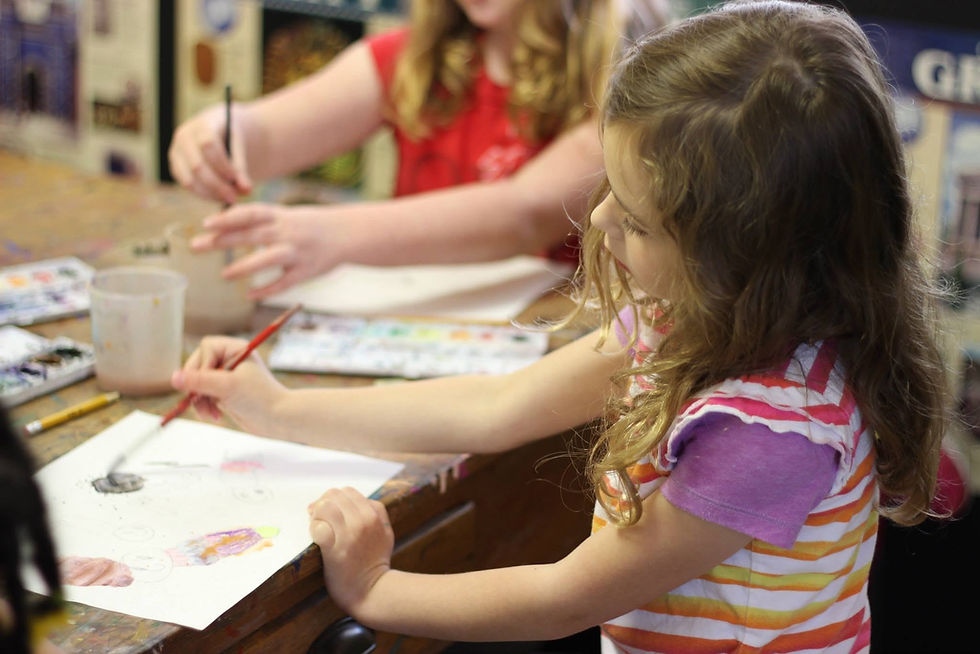

For this reason, the visual arts are an essential part of a Christian education. Beginning in preschool and continuing through high school, students can receive systematic instruction in drawing, painting, sculpture, mixed media, design, color theory, composition, perspective, and a variety of artistic techniques. As students mature, they progressively develop technical skill, artistic confidence, and the ability to thoughtfully create, analyze, and evaluate works of art.
The study of visual arts develops far more than artistic ability. Students learn to observe carefully, notice details others overlook, solve problems creatively, think spatially, communicate ideas visually, plan intentionally, revise thoughtfully, and persevere through challenges. These habits strengthen creativity, fine motor coordination, visual-spatial reasoning, critical thinking, patience, discipline, and thoughtful self-expression while benefiting learning across every academic discipline.

Perhaps most importantly, we believe education should cultivate not only the intellect but also the affections. Scripture calls believers to think about "whatever is true, whatever is honorable, whatever is just, whatever is pure, whatever is lovely, whatever is
Throughout their education, students also have opportunities to display their work and participate in local and state art competitions, encouraging them to develop confidence, receive constructive feedback with humility, and use their God-given gifts to serve others.
Ultimately, our goal is not simply to teach students how to make art. Our goal is to cultivate observant thinkers, disciplined creators, and faithful stewards of God's gifts who recognize that beauty, creativity, truth, and excellence all find their source in the Creator Himself and are to be used for His glory.